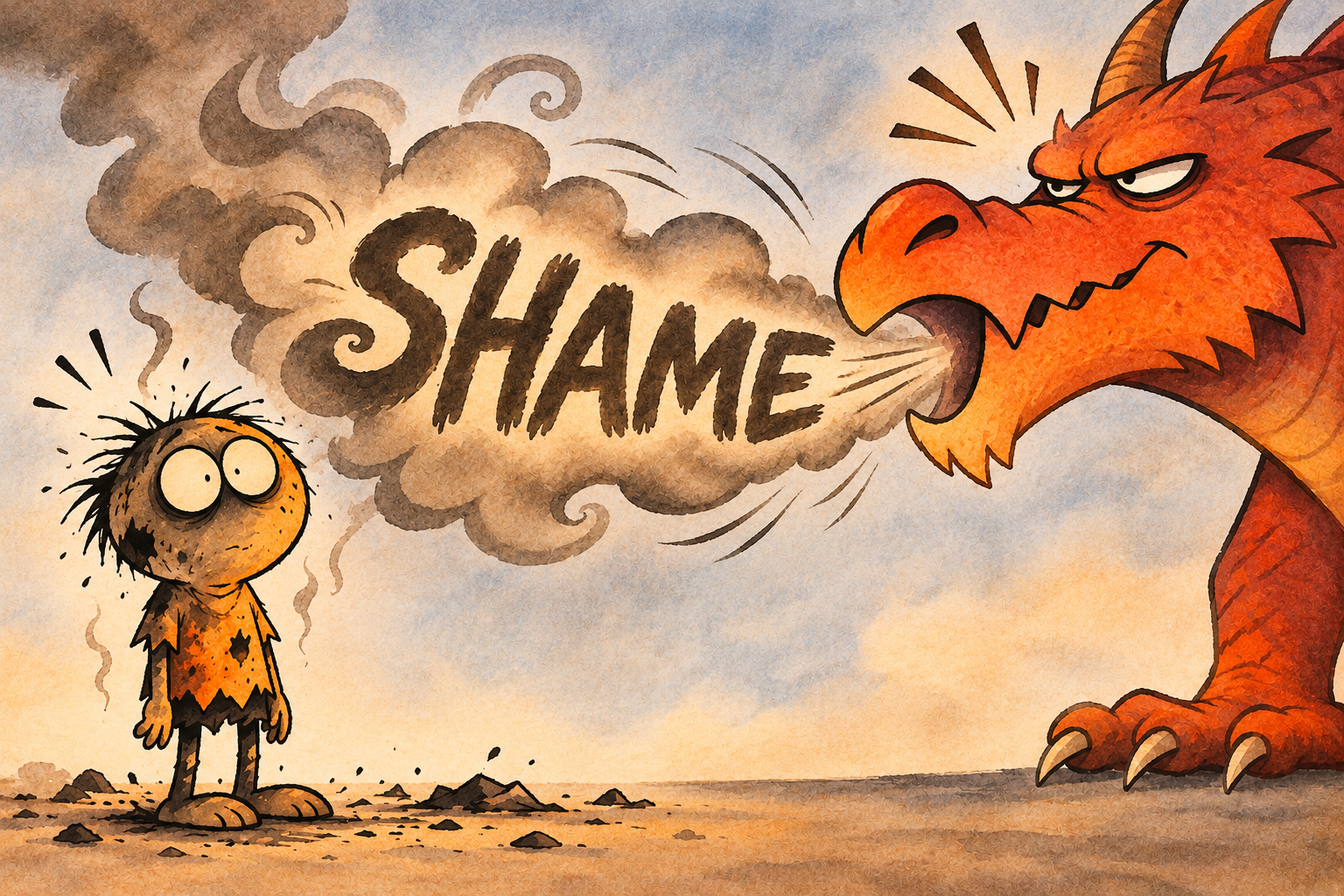
Shame has a terrible reputation in therapy, and for understandable reasons. Chronic shame can be brutal. It can turn a mistake into a judgment about your whole character, make you want to disappear, and keep old humiliations surprisingly fresh long after everyone else has probably forgotten them.
But shame is also a very common human emotion, which suggests it may be doing more than simply making us miserable.
Shame seems to have a social job. It alerts us to the possibility that something we have done, revealed, failed at, or been associated with could lower us in the eyes of other people.
You can often feel this before you have many words for it. Your stomach drops. Heat rises into your face. Your gaze sinks. If only you could undo what just happened.
You say something cruel and notice the other person's face change. You realize too late that you badly misread a situation. You behave in a way that does not fit the person you believe yourself to be.
Shame makes you stop.
Research on shame suggests that it is strongly connected to social evaluation. Across different cultures, what people expect to feel ashamed about tends to overlap with what their communities judge negatively. Some researchers have suggested that shame may help us monitor threats to trust, belonging, and social standing.
That makes a certain amount of sense. Human beings are deeply social. We depend on other people, and it is useful to notice when we have damaged trust or fallen badly out of step with those around us.
Shame can sometimes help us recognize that something needs attention. Maybe there is an apology to make, a rupture to repair, or behavior we do not want to repeat.
The problem is that shame is not always a very accurate instrument.
When the shame detector becomes too sensitive
If you grew up somewhere that affection disappeared when you disappointed someone, mistakes were humiliating, or being different made you a target, your shame detector may have picked up some fairly broad rules:
Don't draw attention to yourself.
Don't get it wrong.
Don't need too much.
Don't let people see that part.
Those rules may once have helped protect attachment, belonging, safety, or simply kept you out of trouble.
The nervous system is not especially fussy about whether a rule is fair. If something seems to work often enough, it tends to remember it.
So years later you make a mistake at work and suddenly wish you were invisible.
You feel like you are in trouble even though you cannot quite name what you have done that is so terrible.
You say no to someone and your inner critic immediately starts announcing your defects.
This is where I find curiosity more useful than trying to argue yourself out of the feeling.
The question I often come back to is:
What is the shame trying to prevent?
From there, things can get more specific.
What just happened?
What does it make you want to do?
Hide? Explain? Apologize? Attack yourself? Make the other person feel better?
Those questions help separate the feeling from the verdict.
Because shame does not require actual wrongdoing. People can feel shame about illness, poverty, rejection, abuse, their bodies, their families, their accents, or any number of things that carry no moral failing whatsoever.
Shame is very interested in whether you might be rejected or judged.
It is much less interested in whether that judgment is fair.
You can feel deeply ashamed and still have nothing to apologize for.
Shame can become a pretty poor judge
Shame arrives with authority. It rarely wanders in saying, perhaps we should take a closer look at what happened.
It already has a case prepared.
I should have known.
Everyone can see it.
I need to get outta here.
Sometimes shame contains useful information. Maybe you did cross a line, act against your values, or hurt somebody.
But there is an important difference between regretting what you did and turning the event into evidence about who you are.
Regret tends to stay close to what happened:
I wish I hadn't done that.
Shame can move very quickly into:
I am not a good person.
That shift matters because this kind of self-attack does not necessarily make us more accountable. Sometimes it does the opposite. We become so preoccupied with our own awfulness that we stop looking clearly at what actually happened.
This is where slowing things down can help.
What did you actually do?
How bad was it?
Is that an observation or a judgment?
What does the situation require now?
An apology? A conversation? A boundary? A change in behavior?
Or perhaps nothing at all, because your shame-o-meter is picking up things as small as a raised eyebrow, a delayed reply, or a mistake nobody else noticed.
Shame can become oddly self-absorbing this way. Instead of dealing with a real social gaffe, all your attention goes toward punishing yourself.
Which, let's agree, is not especially helpful to anyone.
So what do we do with shame?
I don't think the goal is to become shameless.
Most of us want some internal system that notices when we have hurt someone, damaged trust, or behaved in a way that does not sit well with our own values.
The useful work is figuring out how much authority to give the feeling.
When shame shows up, one question can clarify a surprising amount:
Does the size of this feeling fit the size of what happened?
If it does, perhaps there is something to repair.
If it does not, shame may be reacting to an older rule about what happens when you disappoint people, stand out, make a mistake, or become too visible.
Sometimes both are mixed together.
Shame may be trying to protect something important. The challenge is figuring out whether the danger it is responding to is actually here now.